Dear blog reader.
My paternal 3 x great uncle not only left behind my all-time favourite door lintel (see below) but I was also intrigued when I spotted a recommendation by him for a particular kidney pill in the Banffshire Advertiser newspaper (commonly known as the Buckie Squeak) in 1910.
Below, in my usual family history style, I’ll outline William Murray’s life events then I’ll look at his tablet recommendation.
Jacqueline
******************************************
William was born on 23 December 1842 in Rathven parish, Banffshire, Scotland to my 3 x great grandparents, James Murray Farmer and Ann Mair Shavie.
I’ll explain the ‘Farmer’ and ‘Shavie’ here as the ‘Farmer’ will get another mention below (in connection with my favourite door lintel). In the fishing communities of Scotland there are few different surnames and so tee-names or by-names are used as suffices to the surname in order to differentiate between families. My Farmer ancestors originate from the Rathven area and spread out from Buckie, Banffshire to Lossiemouth, Moray and my Shavie ancestors originate from the village of Portknockie near Rathven.
In the 1851 census William was aged 8 and living in Buckie in the ‘Lane North West of the Market’ with his mother and his siblings Helen, Margaret and James (his father was a fisherman so was perhaps away at sea on the day of the census). In the 1861 census William was a 17 year old white fisher and living at 42 Top of the Brae, Buckie with his parents (his father was listed as a white fisher) and his siblings Helen, Margaret, James, George, Ann, Jane and Jessie.
On the 17th of January 1868, William married Ann McKenzie at High Street, Buckie.
In the 1871 census William (a 27 year old fisherman) and Ann were living at 10 Brae Top, Buckie with their sons James and John. In the 1881 census William (a 33 year old fisherman therefore claiming to have only aged 6 years in the 10 years since the last census) and Ann were living at Braeheads, Buckie with 5 of their children, James, John, Ann, William and Lydia Ellen.
In the 1891 census William (now a 48 year old fisherman) was living at 9 Seaview Road, Buckpool, Banffshire with Ann and 8 of their children, James, John, Ann, William, Lydia, Jessie, Nellie and George Alexander. The lintel that William had installed at 9 Seaview Road still exists and ensures that the Murray Farmer tee-name will never be forgotten locally:
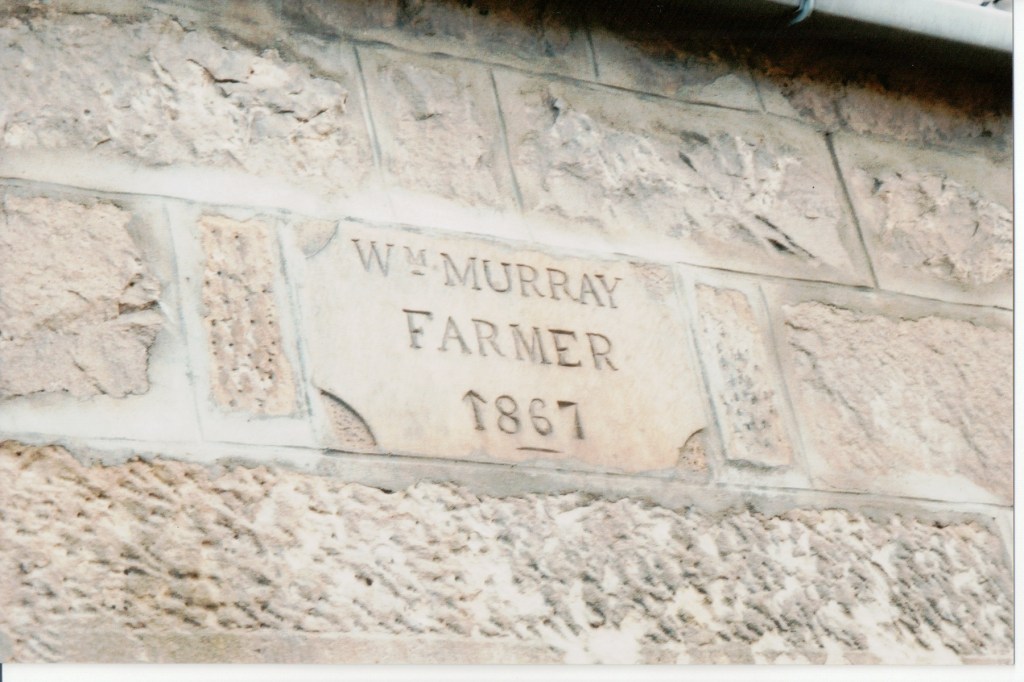
I suspect the year perhaps indicates what William and Ann thought was the year of their marriage.
In the 1901 census William (a 58 year self-employed fisherman) and Ann were living at 9 Seaview Road with 4 of their children, Lydia, Jessie, Nellie and George Alexander. In the 1911 census William (a 68 year old self employed fisherman) and Ann were still at 9 Seaview Road with only their son George Alexander still living with them.
(There will be a separate blog post about George Alexander in the future as his death was extremely tragic. In 1943 the Red Cross ship, Australian Hospital Ship Centaur, of which George was Captain, was sank off the Queensland coast in Australia by a Japanese torpedo. Of the 332 people onboard 268, including George, died).
In the 1921 census William was living at 9 Seaview Road by himself (Ann had died earlier that year) as a 79 year old retired fisherman.
On the 16th of April 1925 William died at his daughter Ann’s house at Netherfield, St Peter’s Road, Buckpool from bronchitis.
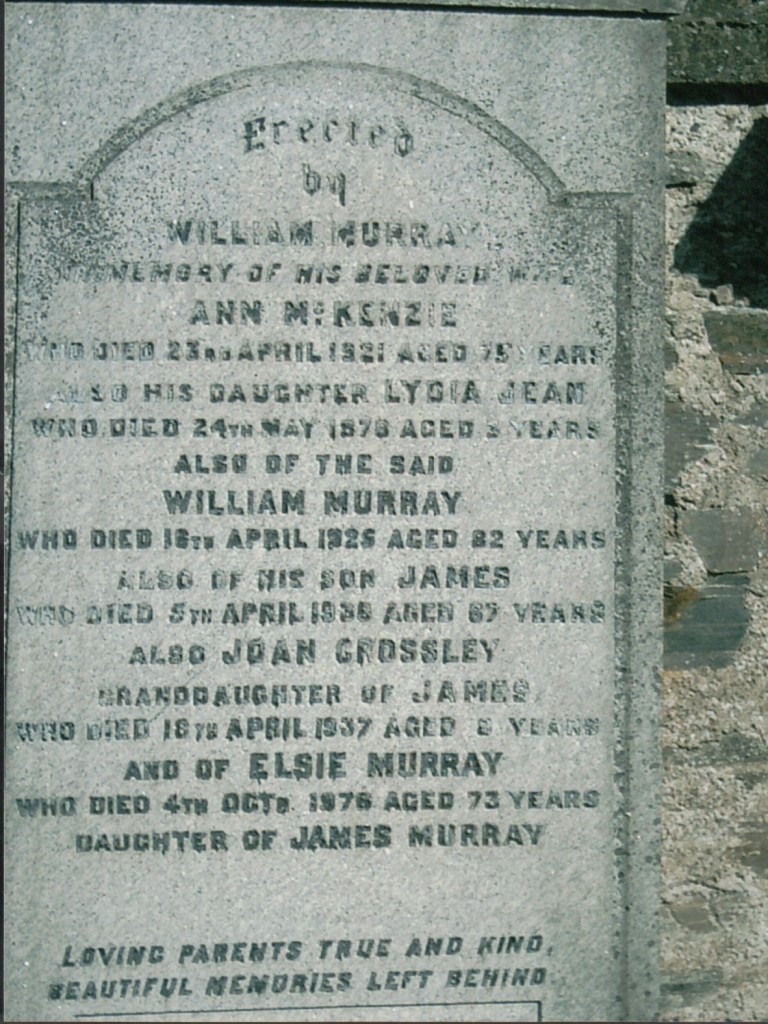
William and Ann and several of their extended family are buried in Buckpool New Cemetery:
We shall now look at William’s kidney tablet recommendation. I shall simply reproduce the newspaper advert word-for-word as it is very detailed.
The Banffshire Advertiser, Thursday, August 18, 1910
Buckie Result.
What is the result here in Buckie? We have heard the good news from neighbouring towns, but somehow nothing has just the same weight with us as the result in our home town. A Buckie result like the following, however, must impress us all.
Mr W Murray, of 9 Seaview Road, Buckie, says:- ‘For no less than twenty years I have been subject to lumbago – a trying pain in the small of the back, just over the kidneys. At times it was very bad, and it was all I could do to get to work. Now and again I was laid up for a week – I often had to walk about bent.’
‘But I am pleased to say that I have found a genuine remedy in Doan’s Backache Kidney Tablets. They have never failed to give me the ease I needed, and to free me from the pain. They surely go to the source of the trouble, and I can heartily recommend them. (Signed) William Murray.’
Do you have rheumatic pains? Backache? Pains in the loins and sides? Dizzy spells? Is the urine high-coloured, painful in passing, scanty or gravelly? Are your eyes puffy? Your ankles swollen? Are you irritable and depressed? Do you soon get tired? If you have to answer ‘Yes’ to any of these questions, you have kidney trouble, and should begin at once with Doan’s Backache Kidney Pills,of which your neighbour speaks so highly. But if you neglect kidney trouble it may end fatally.
Doan’s Backache Kidney Pills are two shillings and ninepence per box, or six boxes for for thirteen shillings and ninepence. Of all chemists and stores, or post free direct from the Foster-McClellan Co., 8 Wells Street, Oxford Street, London, W. Be sure you get the same tablets Mr Murray had.
Sources: birth, marriage and death details and census entries from the Scotland’s People website, newspaper article from the British Newspaper Archive website and photographs taken by Jacqueline Hunter.
 Ancestral Research by Jacqueline