Hi blog readers.
This blog post is about an amazing surprise during a British Newspaper Archive webinar a few years ago when I suddenly spotted a family photo that I’d seen bits of before but never the whole photo.
This is the photo and story that appeared in ‘The Sketch’ (an illustrated weekly journal) on 28th September 1898:
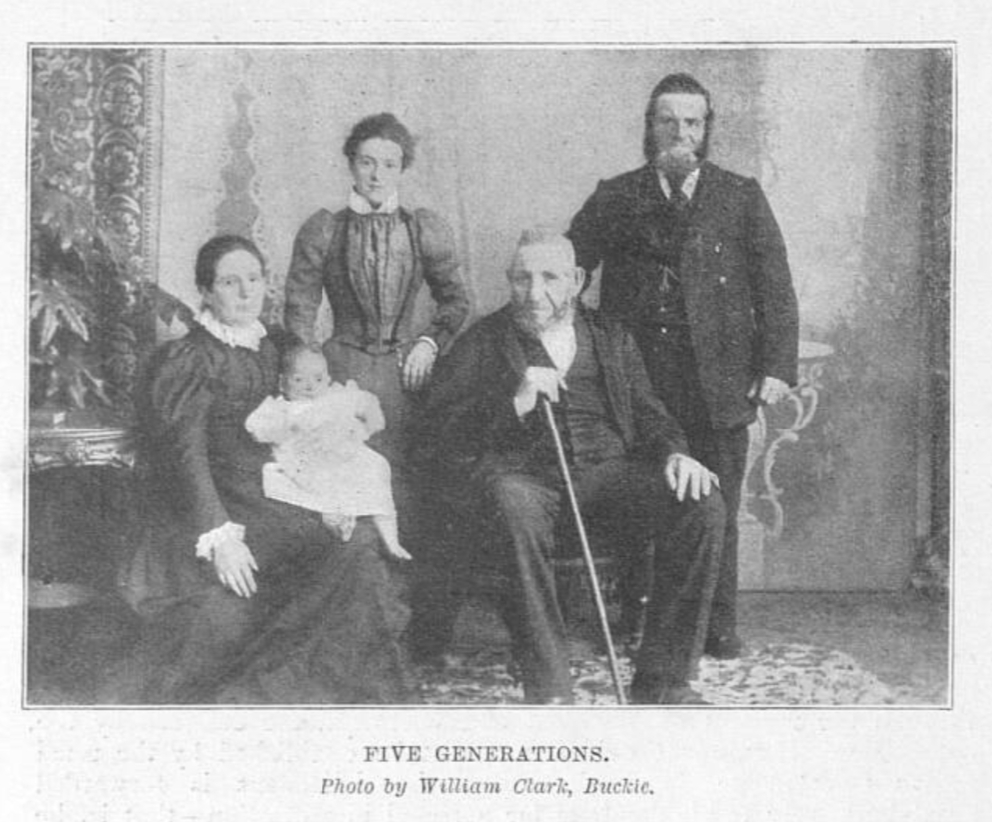
‘Here is an interesting family of five generations.
The patriarch of the five generations is John Murray, who lives at Jamestown, Buckie, N.B. [North Britain]. He was the first fisherman to discover the use of herring bait for catching white-fish, and, though now in his ninetieth year, continue to enjoy excellent health.
His son, William Murray, is sixty-nine; he follows the vocation of his father at Lossiemouth. Mr John Murray’s granddaughter, Margaret Murray, or Cowie, thirty-eight years of age, resides at Buckie; she, again, has a daughter, Margaret, in her nineteenth year, whose infant son, aged six months, constitutes the fifth generation of this unique family of fisher-folk.’
I will now describe the lives of the five people in the picture above.
John Murray is my paternal 4 x great uncle:
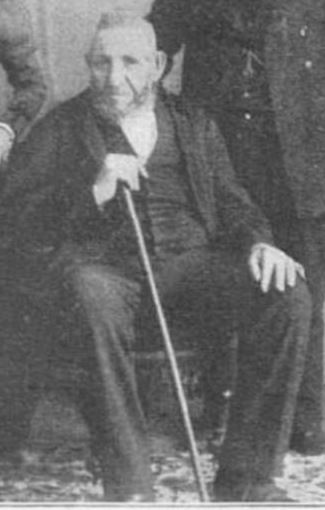
John Murray’s baptism record doesn’t appear in the records of any Church though he clearly believed that he was born in 1808, hence the family photo to celebrate his 90th birthday. John Murray and Margaret Geddes, both of Rathven parish, were married on 13th July 1834 in Rathven parish.
In the 1841 census I suspect John was away fishing as there’s an 1841 census entry in Nether Buckie, now known as Buckpool, for Margaret, 24, and their 3 eldest children, Helen, 6, William (in the main photo above), 4 and Peter, 2. In the 1851 census John, 40 and a fisherman, and Margaret, 38, are living in the lane north west of the market in Buckie with their children, Helen, 16, William, 14, Peter, 13, James, 10, Janet, 7, and Margaret, 2.
In the 1861 census, the family are working away from home at Wilkhaven Shore, Tarbat, Ross and Cromarty and we have, together, John, 48, Margaret, 46, Peter, 22, James, 16, Janet, 14, Margaret, 12, Isabella, 10, John, 6, and George, 3, along with 2 domestic servants Betsy Higgerty and James Geddes. John and Peter were working as fishermen. and John (junior) was at school. In the 1871 census, John, 58, was living at Kinneddar Street, Lossiemouth with his wife Margaret, 57, and their children Margaret, 18, Isabella, 16, John, 13, and George, 11. In 1871 John was a fisherman and John, junior, and George were at school.
In the 1881 census John, 69, and Margaret, 68, were still living at Kinneddar Street and John was still a fisherman. In the 1891 census John, 79, and Margaret, 78, were living at 19 Kinneddar Street and John was now a retired fisherman.
In 1900 John died at 9 Blantyre Place, Ianstown, Buckie, aged 91 years, with a cause of death of decay of old age.
The next oldest person in the photo is John’s son, William:

Similar to his father, there’s no record of William’s baptism in any Church records. We’ve already seen William in the 1841 and 1851 censuses. William married for the first time, on 28th December 1856, to Isabella Smith, a 20 year old from Portessie. Isabella was a domestic servant, William a fisherman and banns were according to the forms of the Established Church of Scotland. In 1861 William and Isabella were clearly near William’s parents: at Wilkhaven Shore, Tarbat, Ross and Cromarty there’s a household comprising of William, 26, Isabella, 26, their 2 daughters, Margaret, 5 (in the main photo above), Ann, 1, and Isabella Sutherland, a domestic servant. Tragically Isabella died of phthisis pulmonalis (ie tuberculosis) on 8th June 1865 at Buckie.
On 28th September 1866, William re-married to Catherine Thomson (who’s actually also related to me on a different ancestral line) at Branderburgh (now part of Lossiemouth) after banns according to the forms of the Roman Catholic Church. In the 1871 census William and Catherine are living at Kinneddar Street, Lossiemouth with 3 children, one from William’s first marriage. William’s household in 1871 consists of William, 37, Catherine, 37, Margaret, 9, John, 3, and Peter, 1. William was a fisherman and Margaret was at school. In the 1881 census William and Catherine are living at 21 Kinneddar Street, Lossiemouth with 4 of their children: the household was William, 44, Catherine, 42, John, 13, Peter, 11, Mary, 6, and Helen, 4. William was a fisherman, John was recorded as both at school and a fisherman and Peter and Mary were at school.
In the 1891 census William and Catherine were living at 42 Kinneddar Street, Lossiemouth with 2 of their daughters as a household of William, 53, Catherine, 53, Mary, 15, and Helen, 14. William was a fisherman and Mary and Helen were both domestic servants. In the 1901 census William and Catherine were still living at 42 Kinneddar Street with a servant, the household comprising William, 63, Catherine, 63, and Agnes Dowie. In 1911 William was a 75 year old retired fisherman and a widower, living at 42 Kinneddar Street, Lossiemouth with his daughter Helen, 34, his son-in-law Alexander Cambell, 37, and his grandchildren, Jessie, 9, James George, 7, Catherine, 5, and Alex, 5 months. Alexander was a fisherman and Jessie, James and Catherine were at school. William died at 42 Kinneddar Street on 10th March 1913 from apoplexy (probably a stroke).
The next oldest person in the photo is John Murray’s grand-daughter Margaret:

Margaret was born on 8 May 1859 in Buckie to William Murray and his first wife Isabella. We’ve already seen Margaret in the 1861 and 1871 censuses. On 27th September 1878 19 year old Margaret married a 20 year old fisherman, Alexander Stewart, at Kinneddar Street, Lossiemouth after banns according to the forms of the Church of Scotland. In the 1881 census Margaret and Alexander were living at 15 James Street, Lossiemouth with this as the household: Alexander, 23, fisherman, Margaret, 21, and Margaret, 6 months (in the main photo above). Tragically Alexander died at sea, off Aberdeen, on the 7th of August 1885. In the 1891 census Margaret was living at 57 Queen Street, Lossiemouth with this household: Margaret, 31, with her daughters Margaret, 10, Isabella, 8, and Alexandrina, 5. Margaret was a grocer and all 3 of her daughters were at school. Margaret re-married on 15th December 1893 at Queen Street, Lossiemouth, after banns according to the forms of the Baptist Church, to a 47 year-old fisherman from Portessie, George Cowie. Margaret was quite the entrepreneur – I guess perhaps she had to be in order to keep her family especially when widowed -when she re-married in 1893 she was a grocery merchant.
In the 1901 census Margaret and George had moved from Lossiemouth and were living at 65 West Church Street, Buckie, with 3 generations as this household: George, 55, Margaret, 41, Margaret (Stewart), 20, Alexandrina (Stewart), 18, Alexander, 6, James (in the main photo above) (Stewart), 3, and Catherine, 6 months. James was Margaret’s grandson and Margaret and Alexandrina were Margaret’s children by her first husband. In the 1911 census Margaret, George and 2 of their children had moved to the west coast to Mallaig (of course another Scottish fishing port) with this as a household: George Cowie, 65, Margaret, 57, Alexander, 16, Catherine, 10, and Amelia Flett, a domestic servant. George and Alexander were fishermen and Catherine was at school.
Margaret died on 24th March 1922 at 35 Ritchie Street, West Kilbride, Ayrshire from apoplexy (a stroke, the same as Margaret’s father William) and hemiplegia ie paralysis (presumably from the stroke).
The next oldest in the photo is John Murray’s great grand-daughter Margaret:

Margaret Stewart was born 27th September 1880 in Lossiemouth. We’ve already seen Margaret in the 1881, 1891 and 1901 censuses. On the 22nd of February 1907 at 67 Oswald Street, Glasgow, 24 year old Margaret married a 20 year old journeyman slater, William Martindale, who was living at Osborn House, Largs. Margaret was living at 222 Elliott Street, Glasgow. This marriage was away from any Church and took place by warrant of the sheriff-substitute of Lanarkshire in front of witnesses Alexandrina Stewart and Mary Elliott. Thus 67 Oswald Street was probably a solicitor’s office. Such a form of marriage usually was due to wanting a quick wedding (often in wartimes there were such marriages via a sherriff’s warrant) or a quiet wedding. We already know that Alexandrina was Margaret’s sister.
In the 1911 census William and Margaret were living at 34 Gateside Street, West Kilbride, the household being: William, 25, Margaret, 29 and their two daughters, Alexandrina, 3, and Margaret, 2. William was a slater and an employer. Margaret died on 20th February 1955 at Silverae, Orchard Street, West Kilbride from a cerebral thrombosis (ie a stroke, similar to the previous 2 generations).
Now to the youngest in the photo, John Murray’s great, great grandson, the baby James:

James Stewart was born on 22nd February 1898 at 65 Church Street, Buckie. James was illegitimate, ie his parents were not married, and his birth certificate has no father’s name. We’ve already seen James in the 1901 census with his mother and grandparents. In the 1911 census James is not with his grandparents or his mother. From then on unfortunately James is a mystery to me. If anyone has James in their family tree please get in touch!
Sources: The photo and article from the British Newspaper Archive website, 1841 to 1901 census entries from the Ancestry website and birth, marriage and death certificates and the 1911 censuses from the Scotland’s People website.


 Ancestral Research by Jacqueline